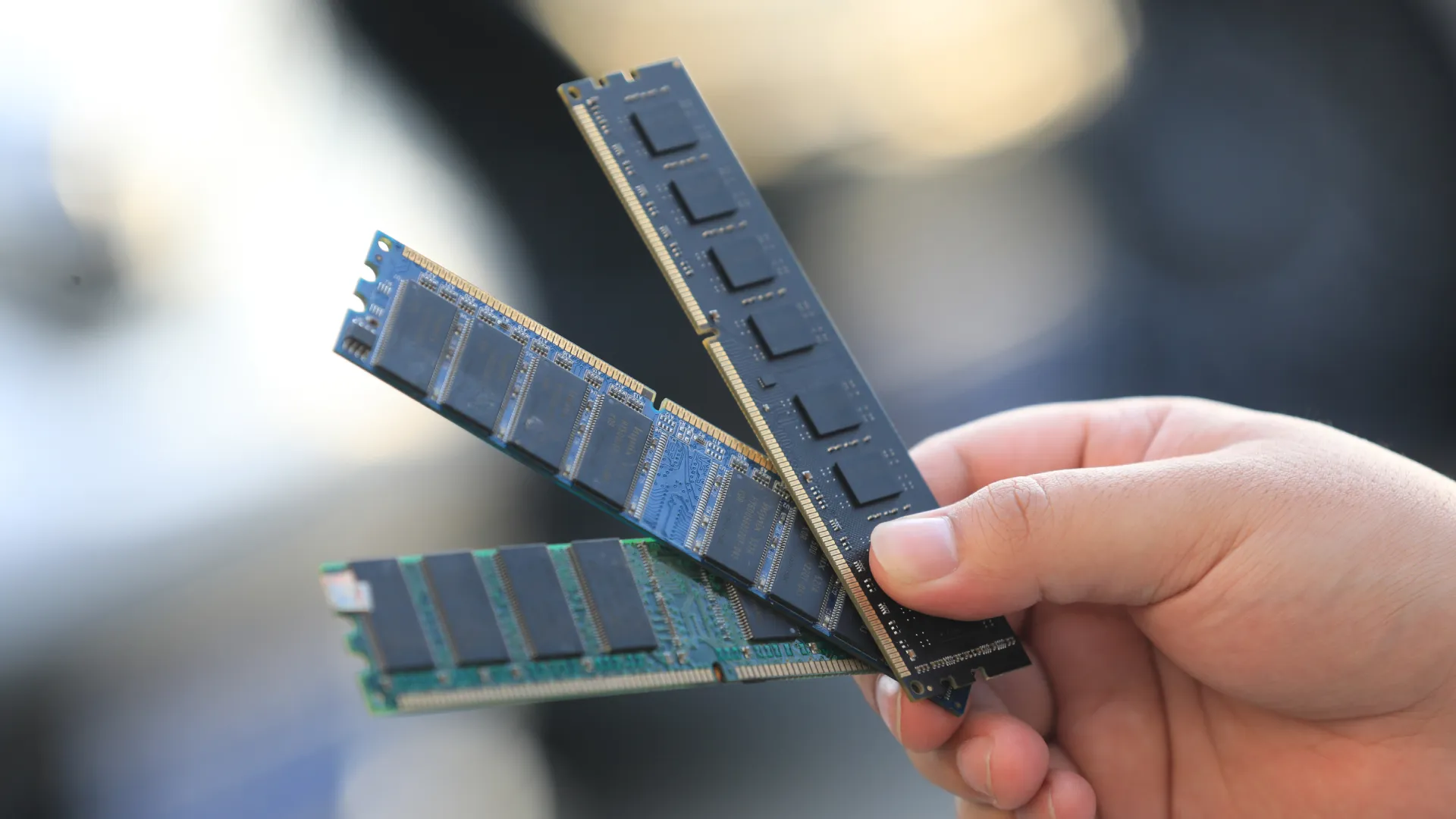
DRAM chip supply to module makers could drop by more than 70% year-on-year in 2027, says Apacer CEO — demand for HBM and server RAM continues to devour manufacturing capacity
Apacer stockpiles $383 million in memory and raises another $124 million to secure supply
Memory supply from major DRAM manufacturers to independent module makers could drop to just 30% of the amount supplied in 2026 next year, according to C.K. Chang, CEO of Taiwanese memory vendor Apacer, further tightening an already squeezed supply chain.
Chang made the comments during the company's 1H 2026 investor conference on July 24, and in subsequent media interviews after the conference. Although memory price increases are expected to slow during the second half of 2026 — reportedly due to consumers deciding that RAM is too expensive — he believes severe shortages will persist into at least the middle of 2027, and that DRAM will remain the most constrained segment.
According to Chang, the greatest risk facing Apacer, which buys memory wafers from manufacturers such as SK Hynix and Samsung and turns them into finished memory products, is no longer overpaying for the chips, but failing to obtain any supply at all.
In preparation for growing shortages and to prevent a wider shortfall next year, the company says it grew its inventory to NT$12.4 billion ($383.2 million USD) at the end of June, up from NT$8.38 billion ($259 million USD) one quarter earlier, representing an increase of approximately 48%. The company is also arranging a five-year syndicated loan of up to NT$4 billion ($123.6 million USD) to purchase additional chips whenever manufacturers make them available, among other needs.
Chang’s projection does not mean worldwide DRAM production will fall by more than 70%. His statement specifically refers to the volume major chip manufacturers may allocate to downstream module companies such as Apacer, which purchases memory chips and packages them into DIMMs, SSDs and embedded storage products. DRAM manufacturers are increasingly reserving their output for high-bandwidth memory (HBM), server memory, and other products purchased directly by large AI and cloud customers.
Samsung, SK Hynix and Micron — the world's biggest memory chip makers — are prioritizing higher-margin HBM and advanced server memory as AI infrastructure spending consumes an increasing share of available manufacturing capacity. Chang estimates that approximately 60% of DRAM capacity is now directed toward server-related applications, leaving conventional DDR4 and DDR5 products competing for a shrinking portion of the market.
DDR5 RDIMM server modules have received some of the most aggressive price increases and retain the greatest potential for future mark-ups, according to Chang. Demand from AI servers, enterprise storage, industrial computers and edge AI systems remains strong, while consumer PC and smartphone demand is considerably weaker and more sensitive to rising component costs. That weaker demand is, of course, mostly in comparison to the AI industry. Consumer demand remains strong enough to mop up the shrinking supply. The RAM shortage is now reportedly affecting the price of cars, far beyond consumer electronics.
Get Tom's Hardware's best news and in-depth reviews, straight to your inbox.
NAND flash is also being pulled into the AI boom. High-capacity enterprise SSDs are increasingly being used for model storage, data staging and key-value cache offloading, allowing colder portions of AI workloads to spill out of expensive DRAM. Flash cannot replace DRAM outright because it offers considerably lower bandwidth, but it can still serve as a tier within AI memory systems, increasing demand for enterprise SSDs and NAND alongside server memory.
Chang expects DRAM contract prices to rise by approximately 30% during the third quarter of 2026 and NAND flash to increase by more than 20%. He expects price growth to moderate again during the fourth quarter.
Elsewhere, analysts project a 40% increase in DRAM prices in Q3 2026, even as demand extends to the oldest standards still in production. Samsung and SK Hynix, both South Korean companies — who together with US-based Micron Technologies control over 90% of the global DRAM market — had earlier warned that shortages could last beyond 2027. And the CEO of Adata projects that the global DRAM shortage will run for another 10 years.
Chinese manufacturers are not expected to provide immediate relief. Chang said Chinese memory maker CXMT’s DDR5 products had become competitive and that both CXMT and Chinese NAND producer YMTC had narrowed their pricing gaps with established international suppliers. However, domestic demand in China already exceeds available supply, while capacity expansion, manufacturing yields, product validation and platform compatibility continue to limit their ability to change the global balance. Furthermore, the prices of new DRAM modules from CXMT are reportedly similar to those of the big three.
Stockpiling memory inventory at historically high prices carries the risk of substantial losses if the market suddenly reverses. Apacer, however, says it has seen no evidence of an approaching collapse. For now, the company is betting that possessing expensive memory in 2027 will be considerably better than having no memory to sell at all.

Follow Tom's Hardware on Google News, or add us as a preferred source, to get our latest news, analysis, & reviews in your feeds.

Etiido Uko is a news contributor for Tom's Hardware covering the latest updates in big tech and the PC industry. He is a mechanical engineer and senior technical writer with over nine years of experience in documentation and reporting. He is deeply passionate about all things engineering and technology, and is an expert in gadgets, manufacturing, robotics, automotive, and aerospace.
-
Moores_Ghost Most of us know the truth and aren't falling for these companies colluding to make max profit. It's not AI. It's not new data centers. This is pure, naked unmitigated greed.Reply
Even if I add the memory in smart weapons that are destroyed on impact, all AI and commercial and scientific building, video game hardware manufacturers together there's still around 40% of the world's RAM making capacity left.
It's not pricing out foreign interest either as even China makes their own now. It is pure boardroom greed after record profits during COVID. They simply do not want to go back to making less money.
Please, Tom's. You have a better reputation than this. -
Razzi16 Agreed.Reply
In late 2023 the memory manufacturers had decided that memory prices were too low, they colluded at that time to collectively reduce capacity over the next year, which would slowly push up the prices, and their profits.
This was then compounded by them, last year, giving almost all of their remaining capacity over to the customers wanting HBM, then everything basically just fell off a cliff.
They got what they wanted. -
SirStephenH Companies stockpiling memory, further increasing demand beyond what is needed at this time, is part of the problem. But of course it wouldn't be an issue if memory makers didn't collude to create this shortage to begin with.Reply -
thestryker It's amazing to me how many people think this is some giant conspiracy. The supply of DDR5 has been stable for years and no capacity has been reduced. The problem of course being no capacity has been added outside of China so the sudden spike in demand is far beyond available capacity.Reply
The closest to collusion one could even get is the DDR4 situation where the big three decided to cut capacity and when demand spiked they didn't increase capacity. This is almost certainly a reaction to the post covid NAND collapse which got bad enough they couldn't sell NAND at cost for a brief moment.
In reality we're in this situation because the memory manufacturers were trying to smooth out the boom and bust cycle of the memory business while taking advantage of the largest profit center at the time (HBM). Now that there's a supply problem they're reaping the rewards like literally any publicly traded company would. While everything going on is pretty horrible it's the system that exists where rationality need not apply when the rich can claim infinite growth.
Got any facts to back that up?Moores_Ghost said:there's still around 40% of the world's RAM making capacity left. -
teeejay94 I honestly couldn't care less what the numbers say, consumer's have power through purchasing it's a well known fact. The less we buy the more of a message gets sent. The entire Im too cool for school who cares about anything mentality will kill this hobby before times up. Not buying is the coolest thing you can do from now on, buy second hand almost every time, the money goes to a seller who's going to buy something else, keep the cycle going and keep the money in second hand market. It's not much but it's enough of a message, it's still 50 billion dollars per year. Any single person on earth or company would cry themselves to sleep going without 50 billion dollars. Do not care what data centres do or spend. People have the power but they have to try. If they say, well there's no money left in consumer electronics so we pull out, let them. Let Nvidia leave the entire consumer market good riddance.Reply -
JayGau Funny how so many people think this is some sort of evil conspiracy. Memory makers have increased their profits by 700% since last year, and you really think it's because people like you and me are buying 32 GB RAM kits for 500$? No, it's AI corporations buying everything they can at any prices Samsung and Micron ask for that is driving this hardware price inflation crysis. Of course RAM makers like it and will do everything they can to make it last as long as they can, but they have certainly not planned this in details for years like a Dr Terror evil mind in his volcano.Reply -
thestryker Reply
It's almost impossible to be further from the truth than this sentence is right now. They could get zero consumer sales through the end of next year and it wouldn't mean anything to the memory makers bottom line. In the meantime a lot of smaller consumer facing companies would likely go out of business though.teeejay94 said:I honestly couldn't care less what the numbers say, consumer's have power through purchasing it's a well known fact.
I want to be very clear that I don't think anyone should be buying unless they have no choice. I wanted to mess around with AM4 a bit since I had a motherboard and opted to order a 5500X3D off aliexpress because a friend had a single 16GB stick of DDR4 I could have and this allowed me to not buy memory. Second hand, if a viable possibility, is a good way to do it if it's going to save money.
At the end of the day though nothing consumers do aside from continuing to protest data center buildouts and not using ai will have any potential for impact in this market. The memory manufacturers do not do direct to consumer selling and the enterprise market has a big supply crisis. This means only consumers and consumer electronics companies are in trouble. -
Conor Stewart Reply
How do you think consumers have power when companies are actively reducing supply for consumers? The manufacturers do not care about consumers, if AI companies or datacentres wanted to take their remaining production capacity they would probably let them, at best maybe they keep a small capacity just to say they still make dram and nand for consumers.teeejay94 said:I honestly couldn't care less what the numbers say, consumer's have power through purchasing it's a well known fact. The less we buy the more of a message gets sent. The entire Im too cool for school who cares about anything mentality will kill this hobby before times up.
You also seem to think it is only "this hobby" that is affected, most of the sales of PCs, phones, etc are from big OEMs selling to companies or from laptop and phone manufacturers. That will have a much larger impact.